


1. The Foundation: The Invention of William Cowper (1860)
Air preheaters of a blast furnace (cowpers) operate continuously, usually in batteries of three or four units. The basic rule in metallurgy is strict: a 100°C increase in the temperature of the inhaled air generates an increase in the productivity of the furnace and a decrease in the consumption of coke, directly reducing the manufacturing price per ton of cast iron.
The performance of a Cowper is dictated by its regenerator — a massive structure of refractory material (on the order of thousands of tons), composed of hundreds of thousands of bricks with vertical voids that form continuous channels for the alternative circulation of hot gases and cold air.
Since the invention of cowpers by William Cowper in 1860, the circulation of gases through these regenerators has been exclusively vertical. .
2. Identification of technological deficiencies (1965)
Strictly vertical circulation has generated a constant problem: uncontrolled turbulence and eddies created in the upper section (the dome of the cowper). This technical deficiency, still present today in separate combustion chamber cowpers (internal or external), has been officially reported since 1965 by German engineer Herbert Boenecke (Düsseldorf) in a study published at a symposium in Austria.
3. Breaking the Barriers: The Galați Experiment (years90)
in the middle of the years90, in Galati, Romania, a regenerator with a modified design was implemented and experimented. For the first time, 41% of the vertical channels of each brick were interconnected by horizontal channels inside the structure.
The objectives of the modification:
Uniformization of gas circulation.
Increasing the heat transfer surface.
Induction of the vortex effect.
Increasing the reliability of the generator.
Although the initial results achieved these goals only partially (mainly in the upper section, reducing the consequences of turbulence in the dome), the experiment proved the viability of the concept of horizontal interconnection.
4. Official performance validation (1994)
In 1994, the Institute of Metallurgical Research in Bucharest executed a thorough technical expertise on this modified cowper, mounted on a 1000 cubic meter furnace in Galati.
The results of the measurements (compared to the classic cowpers in the same system):
Increasing heat transfer surface with 20%. .
Increasing technological efficiency by approximately 5.5% (Calculation performed after the reduction of heat losses through the jacket and cooling water).
an increase of 48°C of the temperature of the inhaled warm air.
5. Global adoption and international recognition
The data obtained in Galati confirmed a major technological leap. This solution for implementing partial horizontal circulation has spread worldwide through the initiative of industrial giants such as USX (US Steel subsidiary) and Mittal Steel, based on direct contracts with the author of the invention.
The innovation has been secured and recognized through multiple international patents:
Japan: 2854985
USA: 5,924,477
Mexico: 203745
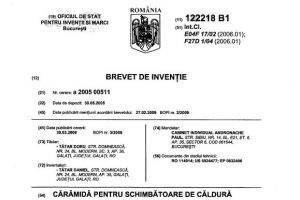
European Union: EP.0832406B1, , ep.1925897
6. Evolution: From Experiment to Bionic Perfection
The tests in Galati represented the foundation. The technical solution presented today by Stove Logic — 3D labyrinth type bionic structure — It is a complete evolution that definitively solves the problem of turbulence, being clearly superior to the generation of the years90 in absolutely all aspects of performance and heat transfer.



Ready to move on to the next generation of preheaters?
Don't let thermal inefficiency dictate your cast iron production price. It now requires the full technical documentation, downloadable 3D models and a comparative analysis applied to your blast furnace data.
Contact us