


Above
underneath
1. The Bionic Approach: Marine Sponger Model
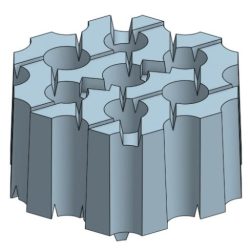
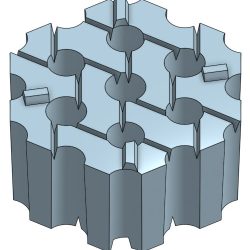
The new type of brick and the structure of the regenerator is a direct application of bionics, mimicking the internal architecture of marine organisms, more precisely the marine sponging.
We completely eliminated the circulation of gases through independent vertical channels. In their place, I designed a 3D maze. It contains horizontal connection channels that join all 12 vertical holes of any brick in the structure.
2. Physical problem: turbulence control
In 2006, Nobel physicist and laureate Richard Feynman called turbulence as “the most important unsolved problem in classical physics”. The transition from a laminar to a turbulent flow of a gas is governed by chaos theory. This instability is proven by the considerable size of the transition zone (Reynolds number between 2000 and 4000), which seriously affects the accuracy of calculations for classic regenerators.
Our invention does not try to guess turbulence, but controls it through a radical approach.
3. Mechanism of action: Forced vortex
We solve the problem of turbulence by manipulating pressure differences at the microstructural level:
Vertical shocks and discontinuities: Each vertical hole in the brick is continued vertically with another of different volume. This design intentionally creates shocks and pressure discontinuities in the vertical flow of gases.
Forced Horizontal Communication: Each vertical hole communicates with 1 to 4 neighboring holes (of different volumes) through horizontal channels located at the level of the upper and/or lower faces of the brick. The pressure differences between the vertical channels mechanically force the circulation of gases through these horizontal bridges.
Thermodynamic effect: These two architectural changes disrupt the vertical flow, generating vortices oriented perpendicular to the direction of flow (horizontal). Thus, the thin layer of gas that normally adheres to the walls of the vertical channel — and acts as a thermal insulator — is destroyed and set in motion by the additional turbulence created. In addition, the horizontal channels directly contribute, through the surface of their walls, to the transfer of heat.
4. The major advantages of 3D technology
The implementation of this bionic maze provides the following technical guarantees:
Guaranteed Vortex: The vortexing of gases occurs in absolutely any vertical channel of the structure. Parameters such as the Reynolds number or the D. sanna curve become irrelevant in this multiple ramification system.
Increased heat transfer surface: Increases up to Over 50%, depending on the area of the structure, obtained without changing the porosity or refractory mass of the current solutions.
Immunity to obstructions: completely undo the consequences of any local blockage. If a stream is obstructed on a vertical section, the gases are efficiently redirected through the rest of the network.
Efficiency and costs: Provides an increase in the technological efficiency of Over 8% And constant, unlimited performance in time, regardless of the type of cowper it is applied to, all at production and implementation costs similar to the current ones.
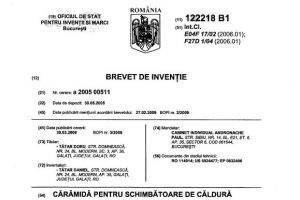


Ready to move on to the next generation of preheaters?
Don't let thermal inefficiency dictate your cast iron production price. It now requires the full technical documentation, downloadable 3D models and a comparative analysis applied to your blast furnace data.
Contact us